
Homepage
Homepage is your start screen for My Own Suite. It brings your apps together in one place, so you can quickly jump between them and keep your setup feeling cohesive.
After signing in and completing setup in Suite Manager, Homepage becomes the natural entry point for your day-to-day use.
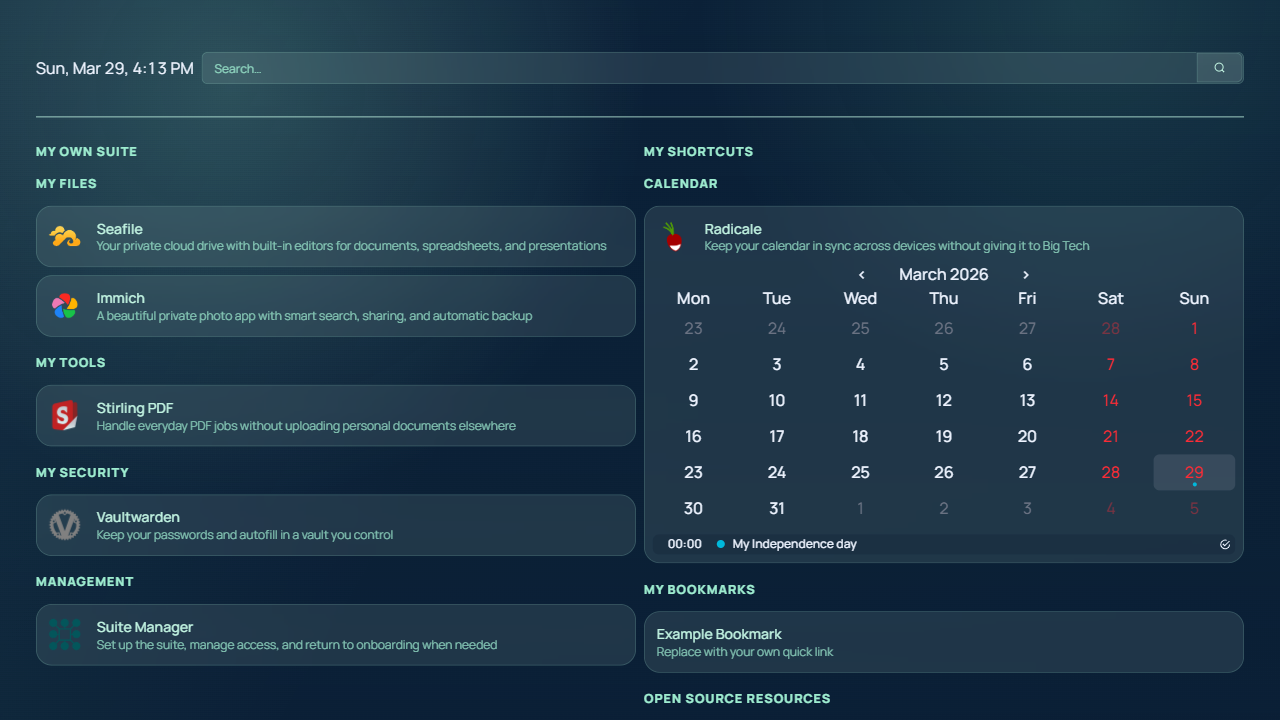
The built-in search bar uses Startpage, a privacy-focused search engine. It is included as a better default for people who want useful search without turning every query into tracked behavior.
Startpage is designed to avoid storing personal search history or building user profiles, while still returning relevant results. In practice, that means the search box on your dashboard stays useful without becoming another place that tracks what you look up.
The dashboard is generated from your current stack configuration:
- If an app is active and has a valid URL, its tile appears
- If an app URL is missing or the app is disabled, that tile is excluded
- After restarting Homepage, visible tiles align with your actual stack
Installed suites keep Homepage customization in persistent runtime files, so your dashboard edits can survive MOS updates without changing the source checkout. Suite Manager includes a simple Customize screen for editing those runtime files directly.
Homepage is optional. If you prefer, you can bookmark individual apps and access them directly. The goal is simply to give you a convenient place to bring everything together.
Technical reference
Section titled “Technical reference”Environment variables
HOMEPAGE_ALLOWED_HOSTS: Allowed hostnames for Homepage (hostname1,hostname2,...).HOMEPAGE_CONFIG_SYNC_URL: Suite Manager config export URL fetched during startup beforeservices.yamlis generated.HOMEPAGE_CONFIG_SYNC_TOKEN: Shared private token sent as a bearer token when fetching Suite Manager-owned config.HOMEPAGE_CONFIG_SYNC_ATTEMPTS: Optional fetch retry count. Defaults to12.HOMEPAGE_CONFIG_SYNC_RETRY_SECONDS: Optional delay between fetch retries. Defaults to2.HOMEPAGE_RESET_TO_DEFAULT: Optional local fallback reset switch. Set to1ortruefor one startup to copy bundled defaults into Homepage’s ephemeral local config before the Suite Manager fetch runs.SUITE_MANAGER_URL: Public Suite Manager base URL used for the Suite Manager resource tile, which appends/setup/.- Any
${VAR_NAME}used in the runtimeservices.template.yaml:- Example:
${SEAFILE_URL},${VAULTWARDEN_URL},${ONLYOFFICE_URL}. - If not set (or empty), dependent tile is excluded from final dashboard.
- Example:
Customizations in this project
- Homepage keeps repo defaults and runtime edits separate.
- Repo defaults are copied into the image at
/app/default-configand are seed material only. - Runtime editable config is owned by Suite Manager and fetched into
/app/configduring Homepage startup. - If Suite Manager config cannot be fetched,
entrypoint.shfalls back to bundled defaults in/app/default-config. - On each startup,
entrypoint.shrunsnode /app/config-generator/dist/index.js /app/configbefore starting Homepage. - Suite Manager is the public login and setup surface for the stack; after sign-in it proxies Homepage instead of Homepage implementing its own login UI.
- Default services template:
/app/default-config/services.template.yaml - Runtime services template:
/app/config/services.template.yaml - Generated output:
/app/config/services.yaml - Generator behavior:
- Replaces
${ENV_VAR}placeholders using runtime environment values. - If any placeholder in a service is unresolved, that full service is removed.
- If a category has no remaining services, that category is removed.
- Recursive nested groups remain supported.
- Replaces
- Result: tiles appear only when their required env values exist.
Runtime files commonly edited for customization:
services.template.yaml: categories, tile order, names, descriptions, and icons.widgets.yaml: widgets.bookmarks.yaml: bookmarks.settings.yaml: general dashboard settings.custom.css: visual overrides layered on top of Homepage defaults.custom.js: client-side theme bootstrapping that keeps Homepage on the bundledtheme-mospalette unless a different theme is explicitly active.docker.yaml: Docker integration settings expected by Homepage.kubernetes.yaml: Kubernetes integration settings expected by Homepage.
Do not edit /app/config/services.yaml directly. It is generated from the runtime services.template.yaml at startup and may be replaced whenever Homepage restarts.
Suite Manager’s authenticated Customize screen edits the persisted source files. Homepage fetches those files during startup and regenerates services.yaml before the stock Homepage server starts.
Current defaults in this repo:
settings.yamlkeeps Homepage’s built-in theme and palette switchers available, whilecustom.jskeeps fallback/default clients on the bundledtheme-mospalette.custom.cssgives Homepage the same MOS brand feel used elsewhere in the suite, including the lighter clean-header treatment and softer card styling.widgets.yamlkeeps the top bar intentionally simple with datetime and Startpage-powered search.- The Suite Manager resource opens the control-plane
/setup/route directly so users can return to onboarding later without guessing the URL.
Tile template example:
- Storage: - Seafile: href: ${SEAFILE_URL} description: Self-hosted file sync and share icon: mdi-folder-syncOptional MOS proxy annotation example:
- My External Services: - Home Assistant: href: https://homeassistant.home.example.com description: Smart home control icon: home-assistant mos: kind: external proxy: enabled: true upstream: http://192.168.30.4:8123 tls: insecureSkipVerify: falseFor external proxy support, href is the dashboard URL and the generated Caddy host is inferred from its hostname. mos.proxy.upstream is the internal absolute http or https origin URL Caddy reverse proxies to; do not include a path, query string, or fragment. mos.proxy.tls.insecureSkipVerify is optional and only affects HTTPS upstreams. Raw Caddy directives/snippets are not accepted in annotations.
Suite Manager exposes the parsed preview on /setup/api/homepage-config/caddy-preview. GET previews the saved services.template.yaml, and POST with { "content": "..." } previews supplied editor content. Preview requests do not write Caddy config, reload Caddy, restart Caddy, or change Homepage output. Applying generated routes requires the host service agent and uses the saved services.template.yaml, not unsaved editor content. When that capability is available, saving or resetting services.template.yaml in Suite Manager automatically applies the generated Caddy routes after the file write succeeds.
Operational commands
- If you changed config in Suite Manager or env values in
deploy/vps/services/homepage/.env:- Restarting Homepage is enough for the fetched config and generated
services.yamlto refresh.
- Restarting Homepage is enough for the fetched config and generated
- If you changed
mos.proxyannotations without the self-host service agent available:- Run
npm run caddy:external-proxies:applyfrom the repo root to apply the saved external proxy routes, validate Caddy, and reload Caddy.
- Run
- If you changed repo defaults under
apps/homepage/config:- Rebuild Homepage image (from repo root):
npm run vps:rebuild
- Rebuild Homepage image (from repo root):
- To reset persisted runtime config to the bundled defaults:
- Use Suite Manager’s Customize screen reset action for the file you want to restore, then restart Homepage.
Troubleshooting
- Check generated config inside container:
docker compose -f deploy/vps/docker-compose.yml --project-directory deploy/vps exec homepage sh -c "cat /app/config/services.yaml"
- Check runtime template inside container:
docker compose -f deploy/vps/docker-compose.yml --project-directory deploy/vps exec homepage sh -c "cat /app/config/services.template.yaml"
- Check generator logs:
docker compose -f deploy/vps/docker-compose.yml --project-directory deploy/vps logs homepage --tail 200
- Common issue:
- Missing env var removes tile silently by design.